Zählwerk

Meter reading? Photo. Done.

One photo. Every answer. All in your hands. Zählwerk reads your electricity, gas and water meters from a photo — and turns columns of numbers into a usage overview you actually enjoy looking at. No account. No forced cloud. Your data stays on your device.

iPhone · iPad · Android — no account, no ads

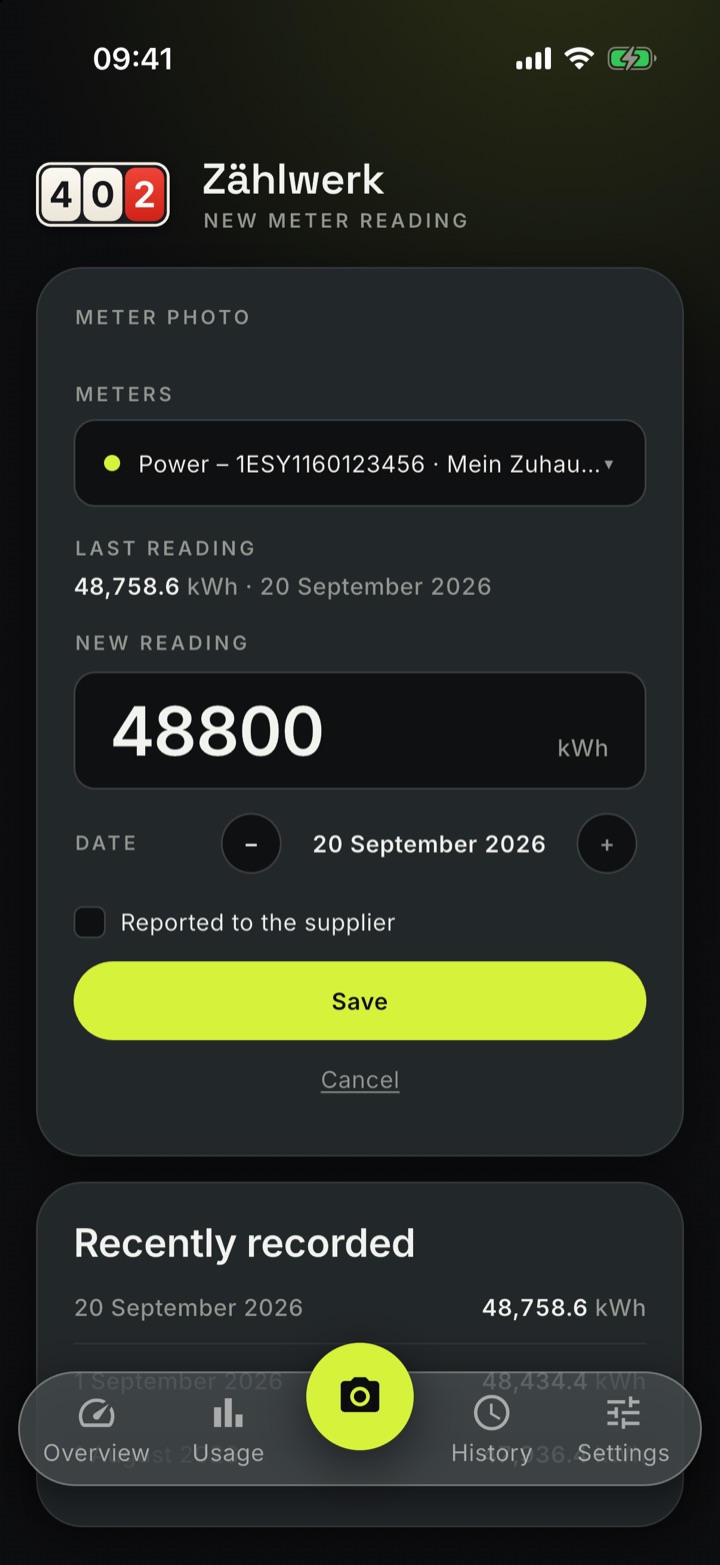
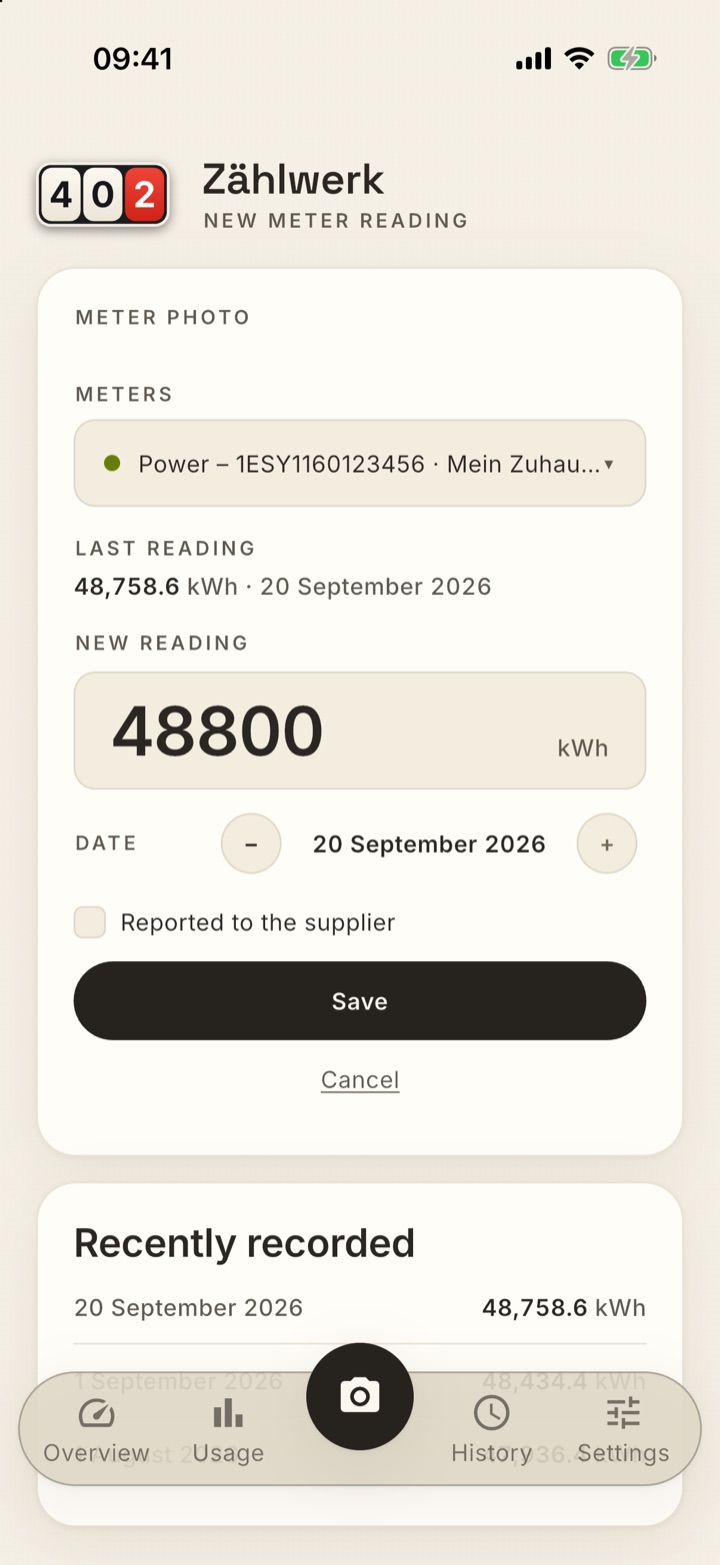
  • New meter reading: meter Power 1ESY1160123456 selected, last reading 48,758.6 kWh from 20 September 2026, new reading 48800 typed in, date 20 September 2026, checkbox “Reported to the supplier”, Save button.
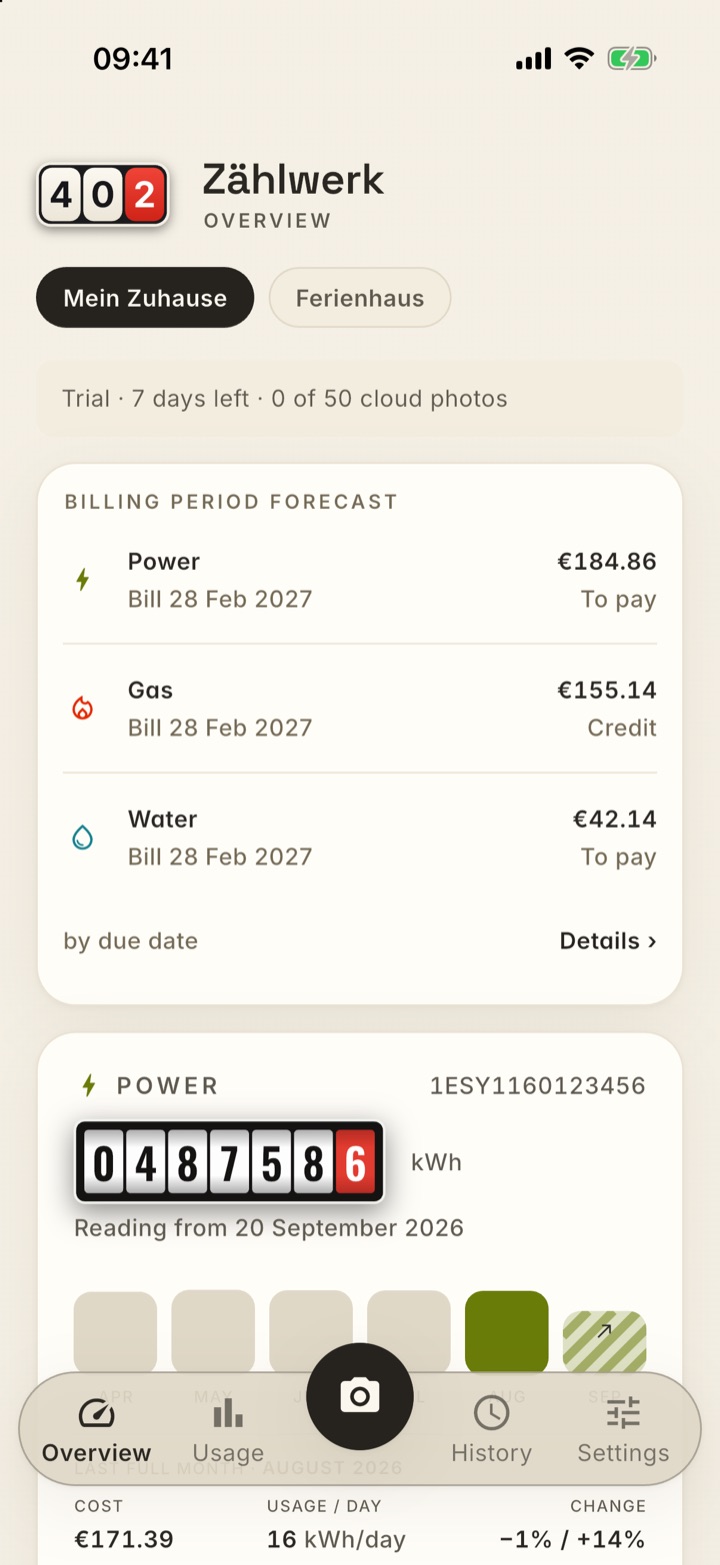
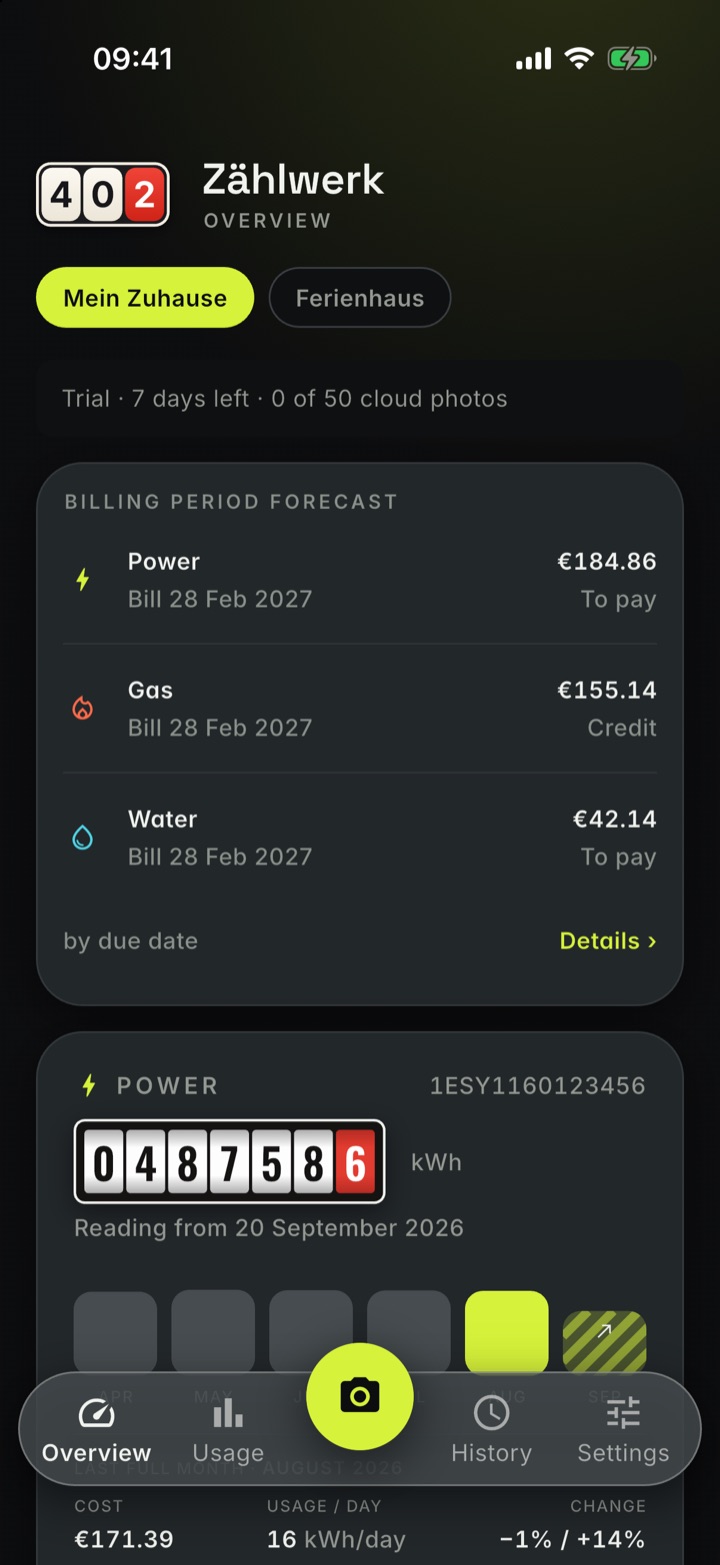
  • Overview: billing period forecast card — Power 184.86 euros to pay, Gas 155.14 euros credit, Water 42.14 euros to pay, all billed on 28 February 2027. Below it the Power card with the drum counter at 048758.6 kWh, reading from 20 September 2026, monthly bars April to September.
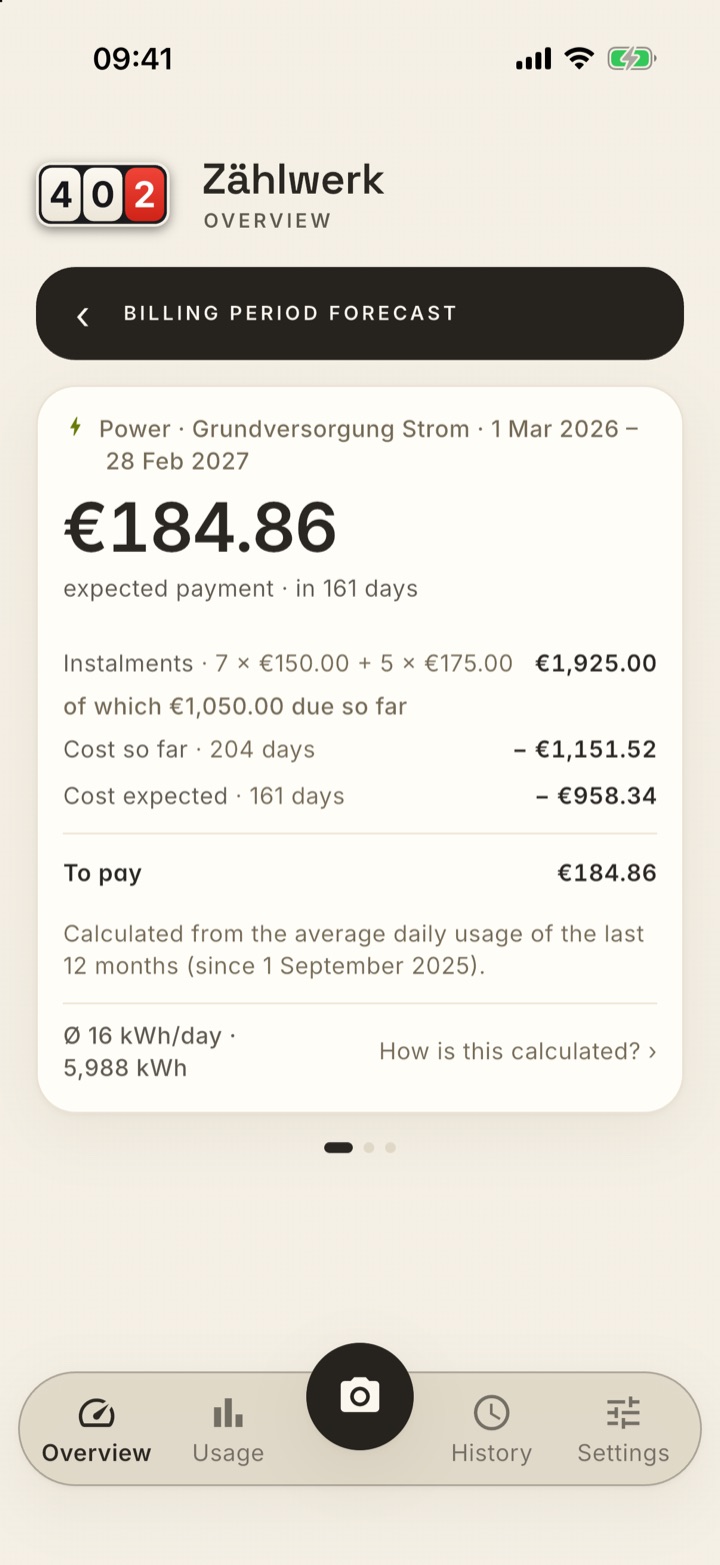
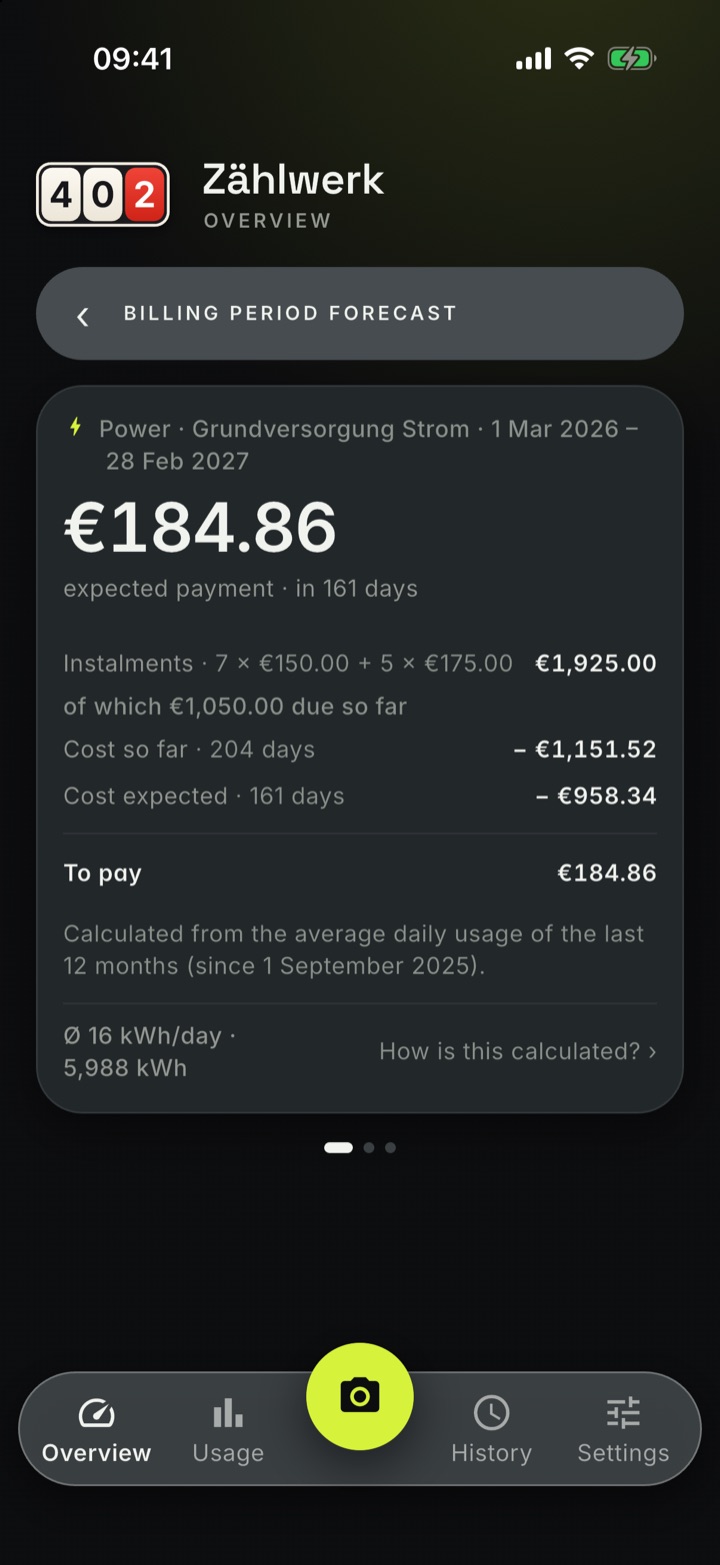
  • Forecast detail for Power, 1 March 2026 to 28 February 2027: 184.86 euros expected payment in 161 days. Calculation: instalments 7 times 150 plus 5 times 175 euros equals 1,925.00 euros, of which 1,050.00 euros due so far; cost so far, 204 days, minus 1,151.52 euros; cost expected, 161 days, minus 958.34 euros; to pay 184.86 euros. 16 kWh per day, 5,988 kWh per year.
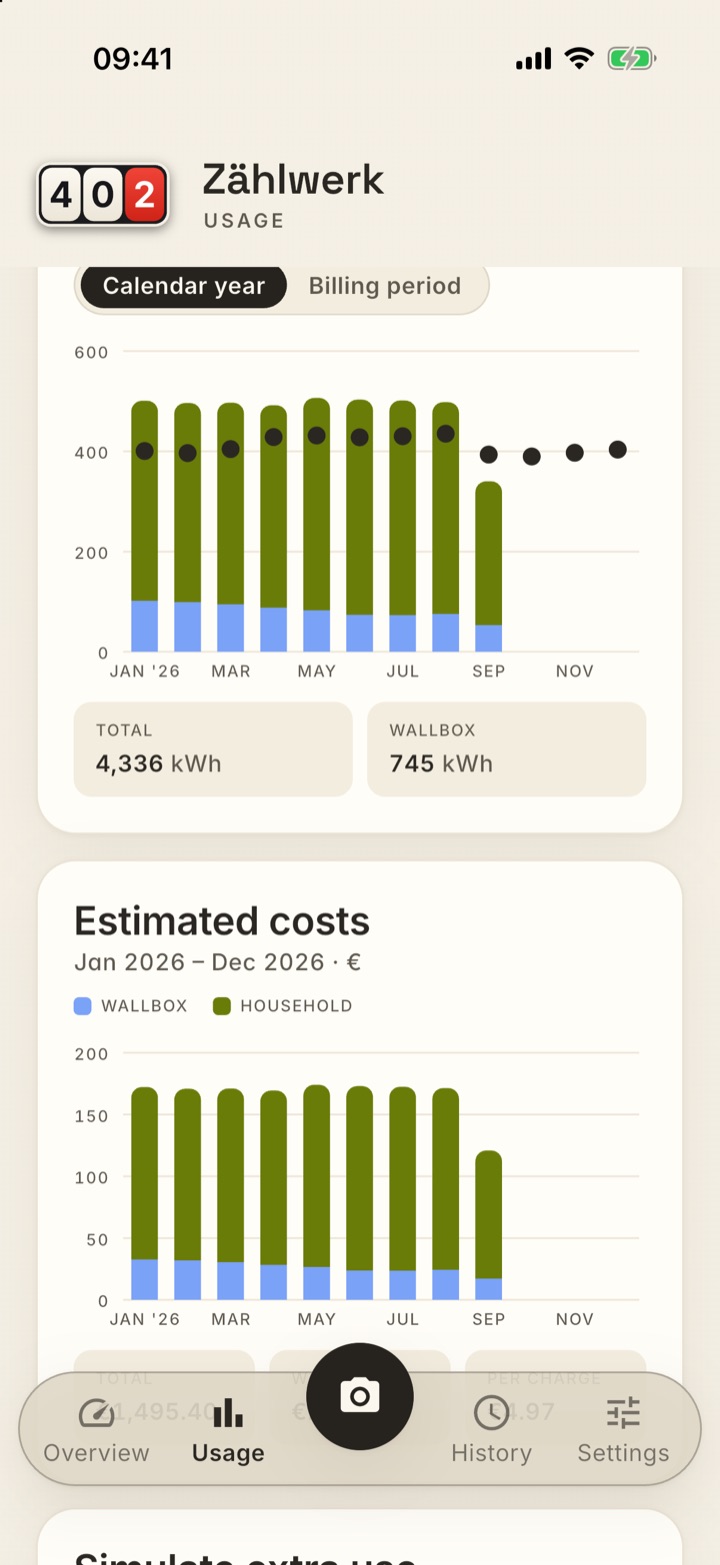
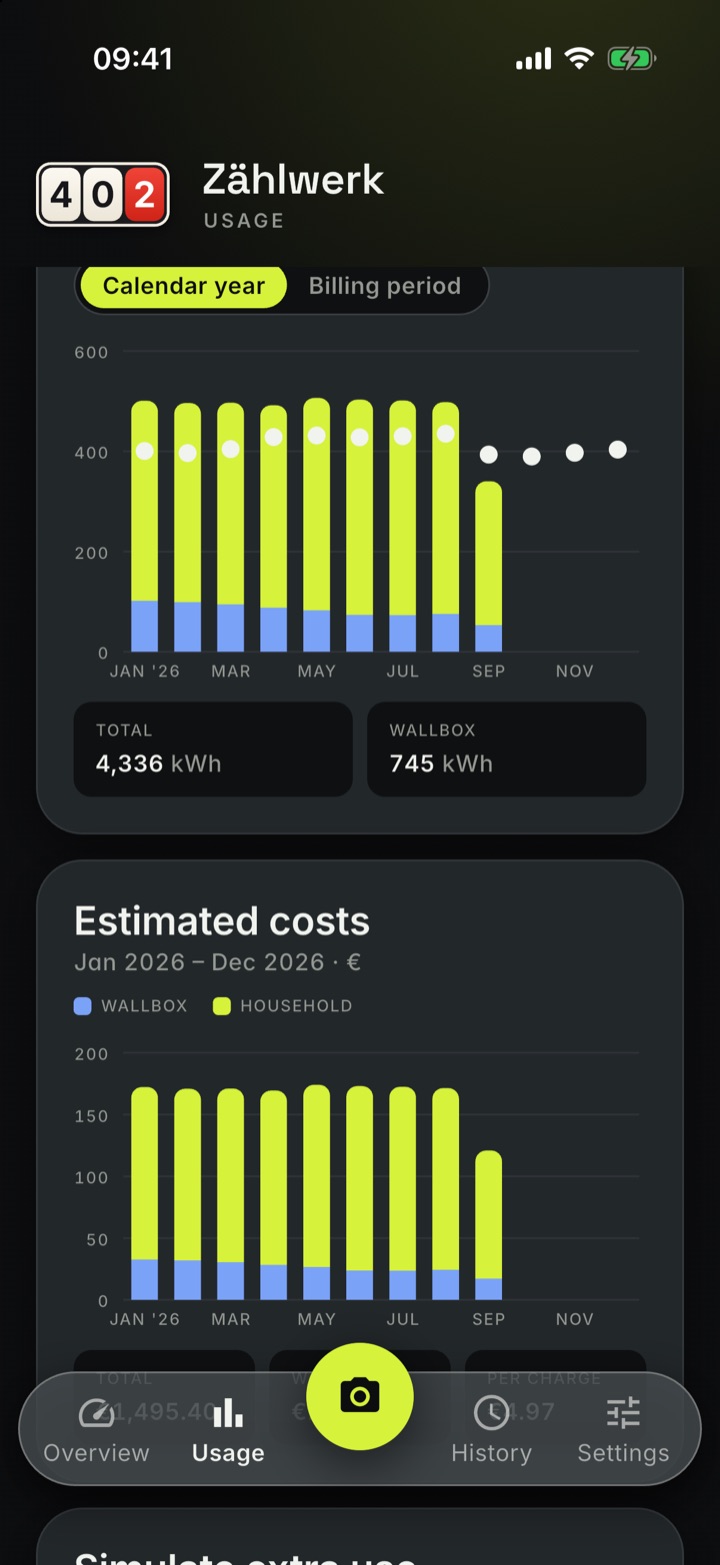
  • Usage: monthly bars January to September 2026 with the wallbox share, total 4,336 kWh, wallbox 745 kWh; below, estimated costs per month for household and wallbox.

Real app screenshots · demo data for illustration

Scraps of paper, Excel, photos somewhere in your camera roll.

Many households have perfectly ordinary analogue meters — and write down their electricity, gas and water readings by hand, month after month: scraps of paper, Excel, photos somewhere in the camera roll. And every year the annual bill still comes as a surprise. There has to be a smarter way.

That is where Zählwerk comes in: you photograph the meter, the recognition reads meter number and reading — you confirm, done. Every reading keeps its photo as proof, and your numbers become a picture you understand at a glance: what the month costs, where the trend is heading and what your bill will say at the end of the year.

Ten seconds instead of paperwork.

Point the camera, done. The recognition knows mechanical drum counters including their decimal drums, finds the meter number and suggests the reading. The app takes the reading date from the time the photo was taken: even last week's forgotten photo ends up in the right month.

Every photo stays attached to its reading as proof. And if you take two readings on the same day, Zählwerk tells you in time, before your statistics go off.

Photo → reading

The app reads the capture date from the photo's EXIF data.

Three reasons, one photo.

Record

Recorded in seconds

Camera button, photo, done: the recognition reads the value and assigns it to the right meter — checked against the last known reading. If it is not sure, it does not guess; you have the final say. If you prefer typing, that works too. A monthly reminder makes sure you never miss a reading date again.

Understand

Understand, don't just collect

The overview shows every meter as a card: the reading as a drum counter, the last six months as bars, plus cost per month, usage per day and the change against the previous month and the average. In the analysis you compare months, years and several addresses — and the forecast tells you what your annual bill will say in the end.

Private

Your data belongs to you

Zählwerk needs no account and no server. Everything is stored locally on your device, locked with Face ID or fingerprint if you like. The only thing that ever travels is a meter photo for recognition — and you decide which route it takes: Zählwerk recognition, your own API key or your own Ollama model on your home network.

What is left of the photo in the end.

Every meter gets a card: the reading as a mechanical drum counter, next to it the meter number. Below, the last six months as bars — the last full month in colour, the current one dimmed with a trend arrow.

And the three numbers that really matter: what the month costs, how much runs through per day and how that has changed against the previous month and the average. The address comparison puts several flats or houses side by side.

Overview: billing period forecast card — Power 184.86 euros to pay, Gas 155.14 euros credit, Water 42.14 euros to pay, all billed on 28 February 2027. Below it the Power card with the drum counter at 048758.6 kWh, reading from 20 September 2026, monthly bars April to September.

Your annual bill, before it arrives.

Enter your unit price, standing charge and monthly instalment. Zählwerk converts your usage into money — month by month, price changes included — and draws up the bill your supplier only sends at the end of the year: expected cost minus all twelve instalments, and there is your expected credit or amount to pay.

  • Average usage per day from the last twelve months — every season counts once
  • Prices and instalments per month, including announced changes
  • If you feed in solar power, the forecast runs the other way: feed-in payment minus the grid operator's instalments

An estimate: as long as you have not measured a full year, the amount is only a rough figure — the app then puts a “≈” in front of it. What your supplier charges is decided by their bill.

Forecast detail for Power, 1 March 2026 to 28 February 2027: 184.86 euros expected payment in 161 days. Calculation: instalments 7 times 150 plus 5 times 175 euros equals 1,925.00 euros, of which 1,050.00 euros due so far; cost so far, 204 days, minus 1,151.52 euros; cost expected, 161 days, minus 958.34 euros; to pay 184.86 euros. 16 kWh per day, 5,988 kWh per year.

Wallbox included.

Zählwerk connects to your Easee wallbox and separates charging from household usage: a meter card of its own for charging, charging usage and cost per session in the analysis — and, if you like, the household “without wallbox”, so your base usage stays comparable.

Usage: monthly bars January to September 2026 with the wallbox share, total 4,336 kWh, wallbox 745 kWh; below, estimated costs per month for household and wallbox.

A photo only ever travels when you take it.

Recognition is the only moment when anything can leave your device — triggered by you, never in the background. You decide which of the three routes it takes. After that the photo is discarded.

Route 1 · default

Zählwerk recognition

The photo goes to the recognition service, and two numbers come back: meter number and reading. Photos are discarded after recognition and are not used to train AI models.

Route 2 · your own API key

Your account, your provider

You enter your own API key for Gemini, Mistral or OpenAI. Recognition then runs under your contract — nothing at all goes to us.

Route 3 · home network

Your own model

With an Ollama model on your own network, even the photo stays at home. No third party, no trip across the internet.

What stays with you in any case

  • Readings and history — in a file on your device.
  • Proof photos — every reading keeps its picture, locally.
  • Tariffs, instalments, forecast — calculated on the device.
  • No account — there is nothing to sign up for.

Everything behind Face ID / fingerprint if you like. Backup and moving to a new phone work through a backup file that you hold yourself — also between iPhone and Android.

Questions, answers.

Where is my data stored?

Exclusively on your device, in a local database. Zählwerk has no server. With the backup function you can export everything — database and proof photos — as a zip file at any time.

Do I need an account?

No. There isn't one. Install the app, add your first meter, get going.

Does photo recognition work with old mechanical meters too?

Yes — the recognition is built for drum counters, knows decimal drums and checks every recognised value against the last known reading. If a photo cannot be read, you simply type the reading in; the photo is still saved as proof.

Does the photo leave my device?

For recognition, yes — only this one photo, triggered by you. By default it goes to Zählwerk recognition and is discarded afterwards. Alternatively you enter your own API key for Gemini, Mistral or OpenAI, or you use an Ollama model on your home network — then even the photo stays at home.

How reliable is the forecast?

It works with your measured usage of the last twelve months, your prices per month and all twelve instalments of the billing year. After a full year of readings it is a good rough figure; before that the app marks the amount as uncertain. What your supplier charges is decided by their bill.

What happens when I change phones?

Export the backup zip, import it on the new device — complete, including all photos. Switching between iPhone and Android works the same way.

Can I import old readings from a spreadsheet?

Yes, via CSV import in the settings under “Export/Import” → “Import data”. Download the template, enter your readings in Excel or Numbers and save them as CSV: Vorlage (Deutsch) · Template (English) · Modèle (Français). The import creates meters and addresses that do not exist yet; readings that are already there are skipped.

What about several homes or a meter replacement?

Zählwerk manages any number of addresses with an address comparison of their own. When a meter is replaced, you join the old and the new meter cleanly — the history stays complete.
Buy once, keep what is yours.

You buy the app once — no account, no ads. Photo recognition is included for the first month, after that it is a small monthly subscription: cancel any time, and everything else keeps working without it.

For iPhone and iPad on the App Store, for Android on Google Play.